
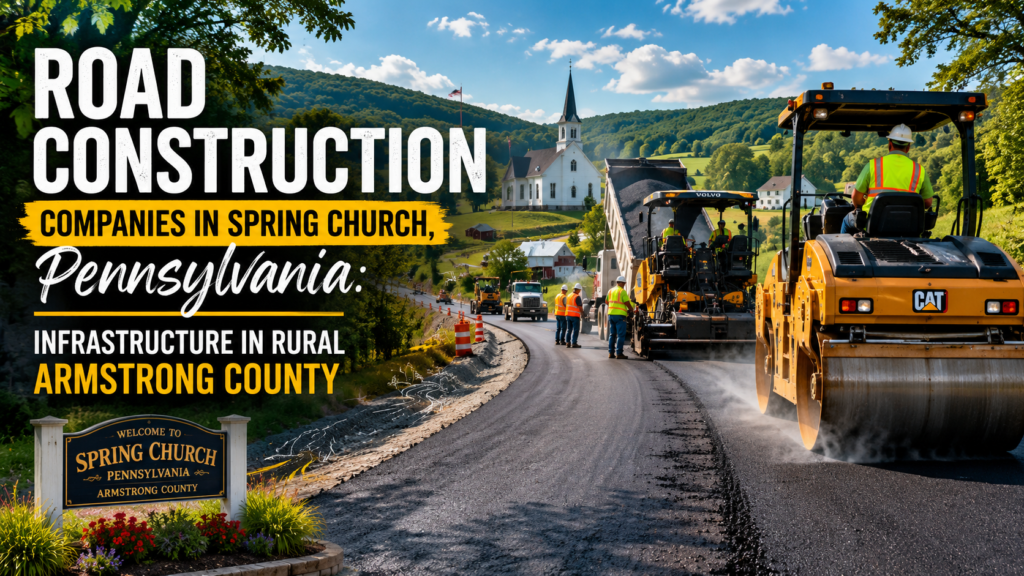
Road infrastructure in Spring Church and the surrounding Armstrong County region is the connective tissue of rural western Pennsylvania life. Route 56 through Spring Church carries traffic between Apollo and Kittanning, serving as the primary artery for residents, agricultural operations, and commercial activity across a wide swath of the county. Beyond this state highway, a network of township roads, private access lanes, farm lanes, and development roads serves the community’s properties. Road Construction Company Spring Church companies operating in this area build and maintain this infrastructure under conditions shaped by the region’s challenging terrain, varied geology, demanding climate, and the practical realities of rural construction work.
The Road Network in Rural Armstrong County
Armstrong County’s road network is divided among several levels of jurisdiction and ownership, each with different standards and funding mechanisms:
- State routes: Roads such as Route 56 through Spring Church are maintained by PennDOT under state specifications and funded through state transportation budgets. Improvements to these roads require PennDOT design review and construction oversight.
- Township roads: Secondary roads maintained by the local townships are built and maintained to PennDOT’s publication standards for secondary roads. Township supervisors manage road budgets and contract for maintenance and improvement work.
- Private development roads: Roads within private developments, mobile home communities, and industrial facilities are the responsibility of the property owner or homeowner association. These roads are constructed to standards appropriate for their use but are not maintained by government entities.
- Farm and access lanes: Unpaved or gravel-surfaced farm lanes and private access roads are common throughout rural Armstrong County and require periodic grading, gravel replenishment, and drainage maintenance to remain passable.
What Road Construction Companies Do in This Region
Road construction companies in the Spring Church area provide the full spectrum of services needed to build and maintain road infrastructure:
- New road construction: Building road systems from raw ground clearing, grading, drainage infrastructure, base course preparation, and paving.
- Road reconstruction: Removing and rebuilding roads that have failed structurally, addressing base failure that overlay or resurfacing cannot correct.
- Overlay and resurfacing: Renewing worn road surfaces with new asphalt overlays when the existing base remains structurally sound.
- Gravel road maintenance: Motor grading, drainage maintenance, and gravel replenishment on unpaved township and private roads.
- Drainage improvements: Culvert installation and replacement, ditch cleaning, and stormwater management improvements that protect road integrity.
- Bridge and culvert work: Many rural roads cross waterways on small bridges and box culverts that require periodic maintenance and replacement.
Western Pennsylvania’s Terrain and Its Effect on Road Construction
The rolling hills of Armstrong County create road construction challenges that differ fundamentally from flat-terrain work. Roads in this region must navigate significant elevation changes, cross numerous small streams and drainage channels, and manage the runoff from steep adjacent slopes. These terrain features shape every aspect of road design and construction:
- Embankment construction: Where roads must cross valleys or depressions, fill embankments must be carefully constructed with appropriate compaction and drainage to prevent settlement and slope instability.
- Cut sections: Where roads cut through hillsides, proper cut slope design and drainage prevent the face from eroding or slumping onto the roadway.
- Culvert sizing: Culverts carrying road drainage must be sized for the watershed they serve. Undersized culverts are a leading cause of road failure in Western Pennsylvania they back up during storm events, saturate embankments, and cause washouts.
- Grade management: Steep grades require special attention to surface drainage, preventing water from running along the road surface rather than sheeting off it.
PennDOT Standards and Armstrong County Road Construction
Road construction companies that work on public roads in Armstrong County operate under PennDOT’s publication standards and specifications. PennDOT Publication 408 establishes the material specifications and construction requirements for all aspects of state and municipal road construction in Pennsylvania. For road construction companies in Spring Church, familiarity with these standards is essential for any work on township or state roads.
Key PennDOT requirements for Western Pennsylvania road construction include aggregate specifications for base and sub-base materials, performance-grade asphalt binder specifications appropriate for the climate, compaction requirements verified through field testing, and drainage structure design standards. Local quarries in Armstrong County supply the limestone and sandstone aggregate that meets PennDOT specifications for base course construction a practical advantage for road construction projects in the area.
Farm Lane and Private Road Construction
A significant portion of road construction activity in the Spring Church area involves private farm lanes and development roads that serve rural properties but are not part of any government-maintained road network. These roads must be built to standards appropriate for their use supporting loaded farm equipment, delivery trucks, and emergency vehicles but are not subject to PennDOT approval for new construction.
Farm lane construction in Armstrong County typically involves surface grading and drainage establishment on the existing alignment, installation of culverts at drainage crossing points, application of an aggregate base course (limestone is the standard local material), and in some cases, asphalt paving of the main lane while leaving secondary branches graveled. The key performance requirements are load-bearing capacity under farm equipment (which can be very heavy), adequate drainage to prevent the lane from becoming impassable during wet conditions, and adequate width and grade management for safe travel.
Conclusion
Road construction companies serving the Spring Church area operate in a rural environment shaped by Armstrong County’s challenging terrain, Western Pennsylvania’s demanding climate, and the practical infrastructure needs of a community where roads are essential connections between properties, farms, businesses, and the broader regional network. Whether working on PennDOT-standard township road improvements, private development road construction, or farm lane maintenance, the principles of quality road construction proper drainage, adequate base preparation, appropriate materials, and attention to terrain remain consistent, and the road construction companies that apply them reliably are the foundation of the region’s infrastructure.